The Soundtrack is You :What Your Playlist Says When You’re Not Speaking
In my younger days, I used to be listening to program called “Saturday Date”. Saturday Date was a cherished radio program broadcast by All India Radio (AIR) Bombay, particularly popular from the 1960s through the 1990s. Airing at 10 PM to 11 PM on Saturdays, the show featured English pop music and allowed listeners to send in song requests and dedications. It provided a unique opportunity for audiences to hear contemporary Western music, which was otherwise scarce on Indian radio at the time.
One of the notable anchors of Saturday Date was Alrick, who served as an announcer for the program. Some of the most frequently played songs included: “Sail Along Silvery Moon” – Billy Vaughn, “Theme from A Summer Place” – Percy Faith, “He’ll Have to Go” – Jim Reeves, “Baby Elephant Walk” – Lawrence Welk & His Orchestra and Don’t Tie Yellow Ribbon – Tom Jones.

Here the interesting part was knowing about the listeners who would send in song requests. Alrick would occasionally make a commentary while reading out dedications by the announcer. Many will remember his fondly tone, building a mood of elegance, nostalgia, and gentleness — rare on radio today.
This was the same period where we saw the Jukebox – the first playlist made in public. It didn’t just play music. It played democracy. And sometimes, Elvis.”
Jukebox was a brilliant contraption, sitting in cafés, diners, bars, and dance halls from the 1940s to the 1980s. It was a mechanical DJ with no judgment, just a numbered list and a glowing promise: Pick your song, and let the room listen with you.
Most jukeboxes held 40 to 100 vinyl singles. You flipped through a catalogue, chose a code (say, B7), and inserted a coin. With a soft mechanical clunk, an arm would grab the record and drop the needle. That moment of silence before the song began. Read my blog on Jukebox with some soulful memories.
It was 1979. Sony released a small, sleek cassette player called the TPS-L2 Walkman — the size of a short paperback. I bought my first Walkman in Bangkok and sported a TDK cassette C90 that had a dark grey tape.
Before the Walkman, music was a public affair — blaring from radios like Saturday Date, playing in restaurants like the Jukebox that was music shared. But the Walkman changed the rules. It whispered: What if the music was just for you?
Fast forward to 2001. Enter the iPod — pocket-sized, white, and smug with its 1,000 songs in your pocket. Unlike the Walkman, it didn’t need physical tapes. It didn’t have “sides.” Instead, it had a clickwheel — and playlists you could create, name, and rearrange endlessly. Playlists that you will use during your morning walks or be your companion in the veranda when you are siting alone having a bourbon

The Walkman was linear. It respected time. Songs came in a fixed order. If you wanted to skip, you had to fast forward with effort, sometimes missing the beginning of the next song. The iPod gave you the seductive shuffle button. It offered choice and chaos, structure and surprise. Want Mozart after Metallica? Done. It wasn’t just listening anymore. It was serendipity as a service.
And more importantly — the iPod introduced us to shuffle. The iPod taught people to surrender. It democratized the song order. One moment Mozart. Next, Metallica.” The iPod made playlists dynamic — editable, infinite, impulsive. But the Walkman was more intimate and immersive. It mirrored a time when people were okay with doing one thing at a time — and doing it fully.
In 1999, we saw emergence of Napster that allowed users to freely (and illegally) share MP3 files across the globe. It wasn’t sustainable. But it changed everything as it introduced the idea that access could trump ownership
When Napster’s chaos became unmanageable, Steve Jobs launched iTunes — a clean, legal platform where you could buy individual songs for $0.99 each. For the first time, albums could be unbundled. iTunes became a success story that revived Apple from the ICU.
In 2006, we saw emergence of Spotify that was launched globally in 2008. Their vision was simple but radical: “Make music easy to access, but hard to steal.”
Spotify offered a legal license model, gave access to searchable, endless catalogues of music, offered playlists as culture (Discover Weekly, Release Radar, Wrapped) and used smart algorithms for recommendations
Spotify today rules the world of personalized music.
When I spoke about the evolution of listening to playlists to my Professor Friend, he said that “Spotify isn’t a music app. It’s a mirror as it reflects the personalities”.
I was surprised with his comment and so he categorized the Spotify listeners into following categories calling them as Spotify Species.
- The Playlist Purist
Behaviour and Diagnostic:
Creates themed playlists for every conceivable human condition: Morning Walks, Work hours, Trying to sleep at night. These people manually build playlists and obsessively reorganize track order. These are the librarians of the soul. You don’t borrow their playlists — you visit them, respectfully, and return better.
- The Shuffle Nomad
Behaviour and Diagnostic:
Has hundreds of liked songs but rarely revisits. Hits shuffle, always. Doesn’t remember what played yesterday, nor care about it. These are generally impulsive people and can get easily bored. They are emotionally agile (or rather chaotic)
- The Algorithm Believer
Behaviour and Diagnostic:
Religiously trusts Discover Weekly, Release Radar, and Daily Mix. Believes Spotify understands them better than their closest friends or the therapist. These people can be optimists, delegator and emotionally outsourced (I didn’t really get this term). They never make their own playlists. They bow before the algorithmic altar — but strangely find exactly what they need.
- The Nostalgia Drifter
Behaviour and Diagnostic
Listens to the same 40 songs from 1997 or 1960 depending on their age. These people are sentimental, resist the change but are emotionally faithful. They don’t like to explore much and use Spotify like a jukebox. They also plays full albums in order (still believe in Side A and Side B). No shuffling.
I thought his classification of personalities based on how people played music was interesting. I simplified his analysis into three categories instead of four and sketched the diagram on the paper napkin. I asked Professor’s opinion. Professor didn’t say a word but I could see that he was amused.
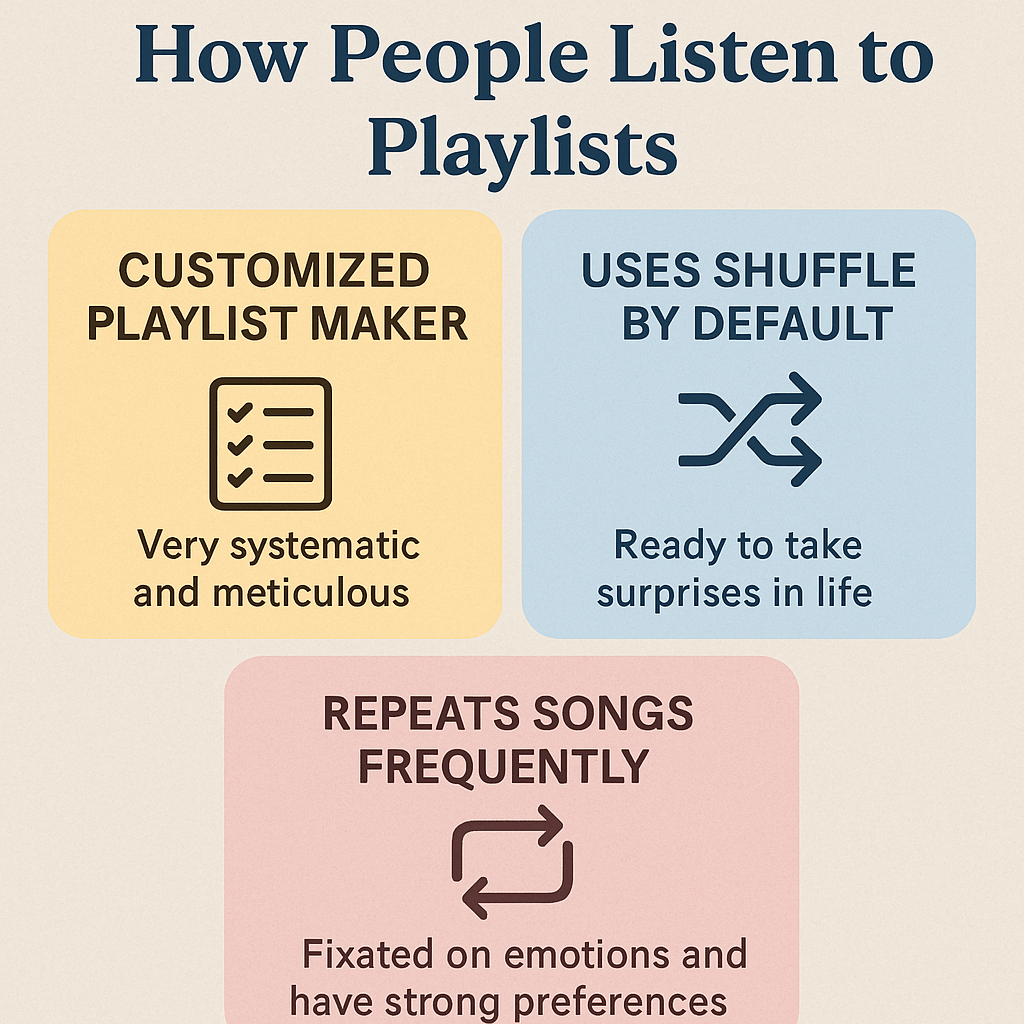
As he extinguished his cigar and asked for the bill, he asked me in a very casual tone “Dr Modak, can I borrow your playlists? And what’s the playlist setting you follow?”
I behaved as if I heard nothing!
Very nice read. 👌👍
Nice read as always.
Silence speaks…so even the noise should be made silently
Pre monsoon showers can trigger nostalgia and produce wonderful posts. Such as this one. Loved the expressions: “Spotify isn’t a music app. It’s a mirror as it reflects the personalities” and “emotionally outsourced” 🙂
You and your friend have covered behavioural segmentation and consumption based persona on a Saturday morning. And traced the evolution of music consumption.