Your Garbage Tells Too Much
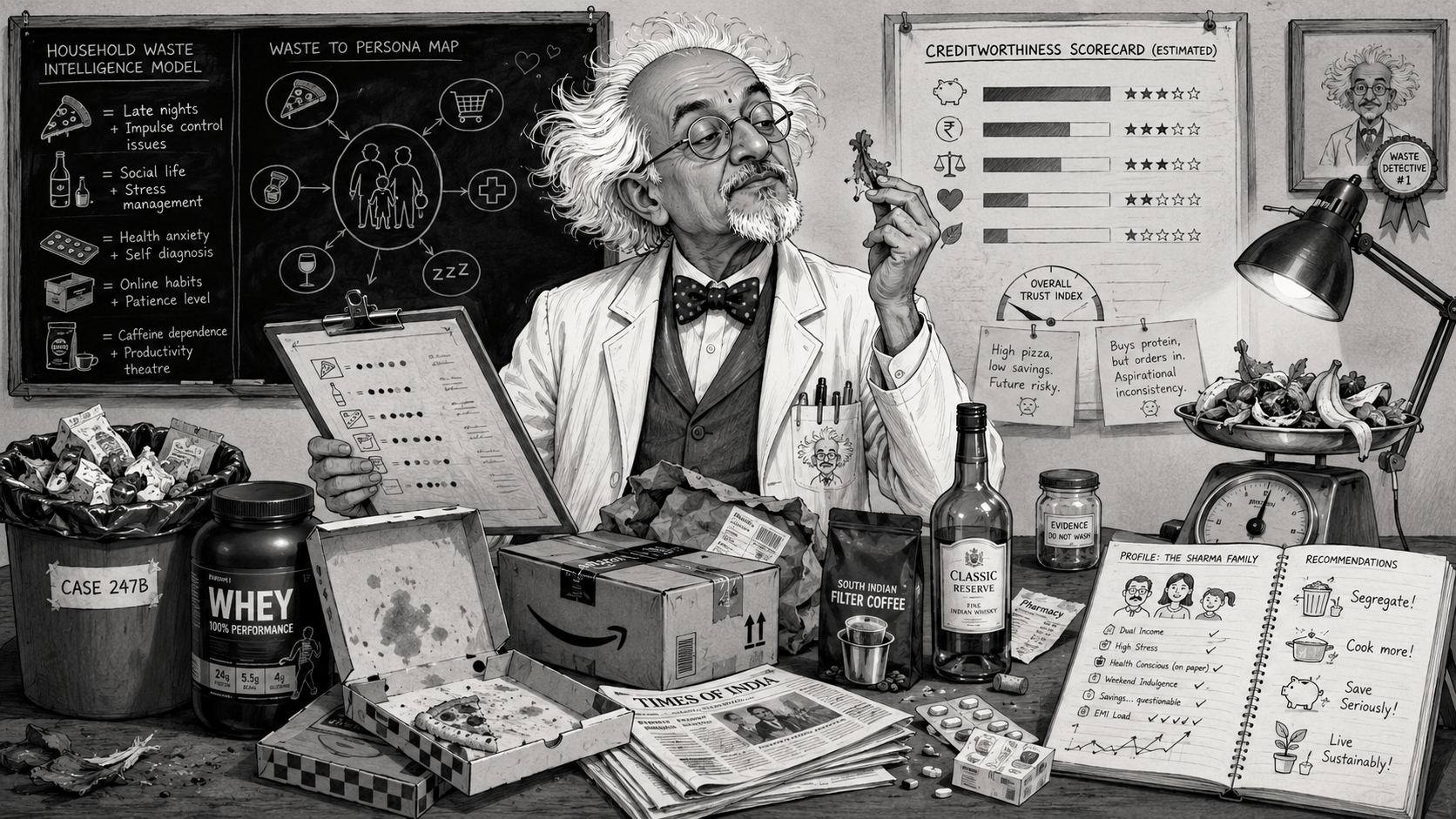
How waste auditors may one day know your family better than your bank.
There was a time when understanding a family required patience. You had to visit their home, meet the children, notice the books on the shelves, listen to the conversations over dinner and perhaps speak discreetly to the neighbours.
This was inefficient.
Today, all you may need is their garbage bin.
My Professor introduced me to this new branch of behavioural science one morning when he arrived carrying a clipboard, a weighing scale and the expression of a man about to discover something important about humanity.
“We are conducting a household waste characterisation study,” he announced.
“For a municipality?”
“No. For a family.”
“The family knows?”
“That is not a good idea as it will contaminate the sample”
The target household lived in a respectable apartment building in Mumbai. We had access to one week’s waste, neatly accumulated in bags outside their door every morning. The Professor wore gloves, I carried the weighing scale, and between us we had all the qualifications necessary.
The Science of Knowing People Through Waste
We began professionally.
Wet waste: 38 per cent. Paper and cardboard: 24 per cent. Plastic packaging: 18 per cent. Glass: 8 per cent. Metal: 2 per cent. Sanitary and miscellaneous waste: 10 per cent.
The Professor looked pleased. “A healthy dataset.”
I asked how a dataset could be healthy when much of it smelled of yesterday’s fish curry, but he had already moved on from waste characterisation to family characterisation.
There were large quantities of vegetable peels, which I interpreted as evidence of a traditional household. The Professor preferred “health-conscious”. Then we found three pizza cartons, several packets of quinoa and two empty packets of frozen samosas.
He revised the classification. “Health-conscious with periodic realism.”
This was our first major insight. Human beings may have one lifestyle, but their garbage usually has several.
Amazon Reveals the Income Group
Cardboard formed an unusually large fraction of the dry waste. There were Amazon boxes, courier envelopes, bubble wrap and pieces of packaging whose original contents could no longer be identified.
The Professor immediately upgraded the household to upper-middle-income.
“How can you tell?”
“Packaging intensity.”
Apparently economists had been wasting their time with income surveys.
A lower-income household repaired things. A middle-income household replaced things. An upper-middle-income household ordered things online and then spent the weekend wondering where to store them.
We found packaging from an expensive coffee machine, which confirmed upward mobility, followed by a humble packet of ordinary filter coffee, which complicated matters.
“Transitional,” said the Professor.
The household, it seemed, aspired to Milan while remaining emotionally attached to Matunga, a south Indian middle class suburb of Mumbai.
The Intergenerational Coexistence Ratio
Next came newspapers. Not one, but three: an English daily, a financial newspaper and a Marathi daily.
“Senior citizen,” I said.
The Professor nodded. “Probably male. Sixty-five plus. He still believes important news must leave ink on the fingers.”
Nearby were medicine strips, vitamin tablets and antacids, which he took as confirmation until we discovered a large tub of protein powder and two energy-drink cans.
“Young male. Gym-going.”
Then came a packet of chia seeds.
“Possibly the same male after consulting Instagram.”
By lunchtime we had constructed an entire four-person household without meeting anybody: grandfather from the newspapers and medicines, father from the financial paper and coffee machine, mother from the vegetables and online shopping, and son from the protein powder, pizza and energy drinks.
The complete absence of evidence linking any object to any particular person did not trouble us.
The Family Sustainability Index
At this stage the Professor felt that merely describing the household was insufficient.
“We need an index.”
We consultants feel uncomfortable until observations have been converted into numbers.
So we developed the Family Sustainability Index, or FSI. (Don’t confuse this with the Floor Space Index that decides Mumbai city’s metabolism). Points were awarded for vegetable waste, recyclable glass and evidence of home cooking, while multilayer plastic, food-delivery containers, disposable cutlery and imported mineral water reduced the score.
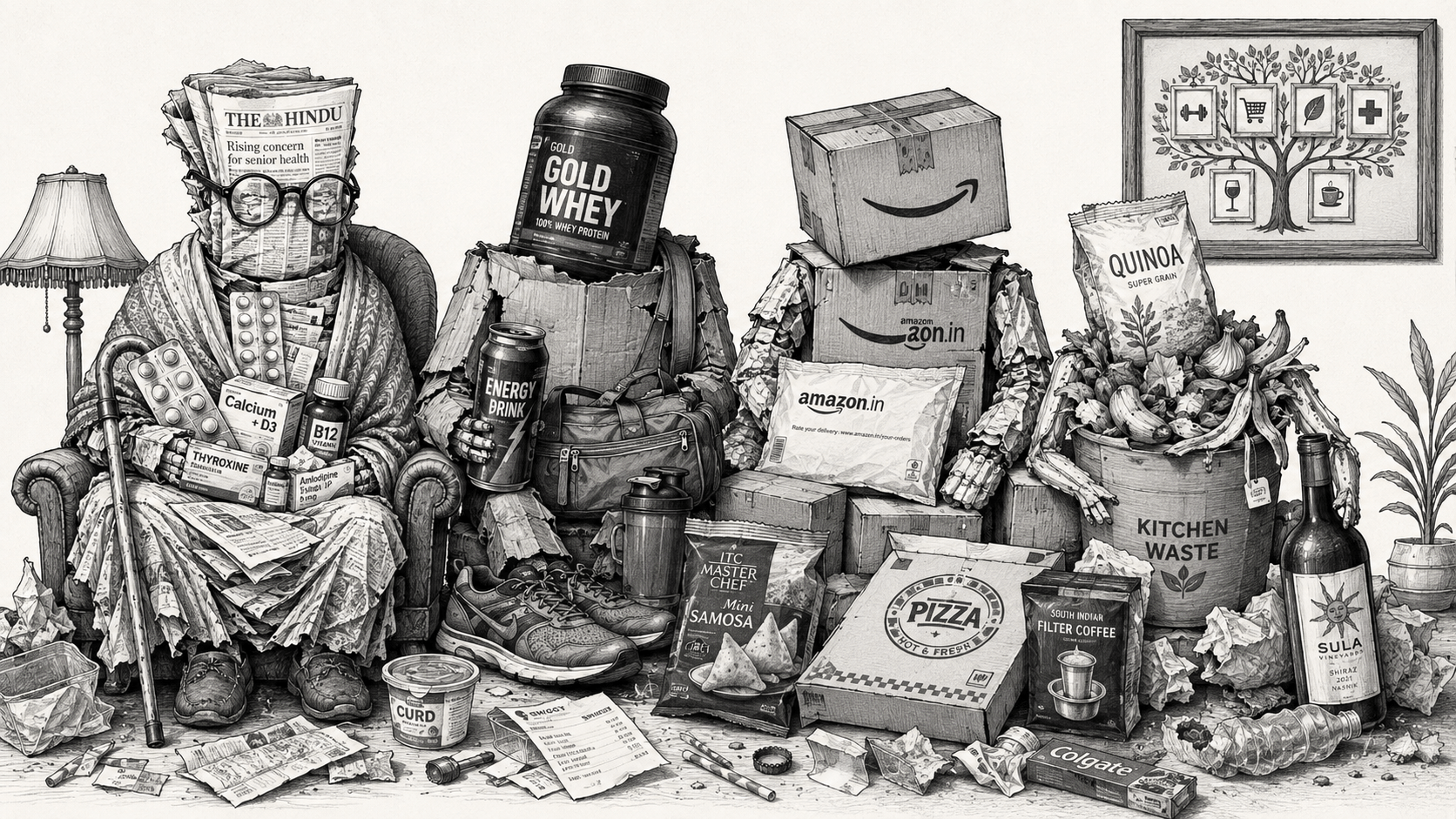
The household obtained 67 out of 100.
“What does 67 mean?” I asked.
“Moderately sustainable.”
“Why?”
“Because 68 would be slightly more sustainable.”
That settled the methodology.
We then developed a Domestic Harmony Index, based on the profound sociological principle that families who eat together generate common packaging, while families in distress generate individual delivery orders.
One large biryani container suggested togetherness. Four different takeaway containers suggested fragmentation. A single dessert ordered separately was treated as an early warning indicator.
The household initially scored 73, until we discovered two food-delivery bags from the same evening, one containing North Indian food and the other sushi.
The score fell to 61.
“Cultural differences?” I asked.
“Possibly.”
“Marital?”
“We should not speculate.”
This was encouraging because speculation was essentially all we had been doing since breakfast.
Bottles Tell the Truth
Then we reached the bottles: two wine bottles, one whisky bottle and several soda bottles.
The Professor suddenly became cautious.
“Alcohol data requires context.”
This was the first time context had entered our methodology.
One wine bottle, he explained, could mean sophisticated dining; two could mean guests; three could indicate stress; and four could mean guests causing stress.
The whisky bottle was an expensive single malt. I suggested a senior executive, while the Professor proposed a retired consultant, which seemed unnecessarily personal.
Still, the household’s estimated financial profile rose.
Then came Wednesday’s waste: a cake box, six paper plates, soft-drink bottles and a broken balloon.
“Birthday,” I said.
The next morning there were two more wine bottles.
“Continuation of birthday?”
“Or recovery from birthday.”
By Friday the vegetable fraction had fallen sharply while food-delivery packaging doubled. Our model detected deteriorating lifestyle behaviour and weakening domestic discipline.
Then the building watchman casually informed us that the family cook had been on leave for three days.
One domestic worker’s absence had altered the household’s sustainability rating, dietary profile and domestic harmony index.
The Professor entered a new variable in the spreadsheet: External operational disruption.
We consultants have a phrase for everything.
When the Family Found Out
Unfortunately, someone eventually noticed two elderly gentlemen examining their garbage.
The family was informed.
From Monday onward, the waste became exemplary. The whisky bottles disappeared, vegetable peels increased, newspapers were folded neatly, plastic packaging declined and someone had even washed the yoghurt containers before disposal.
The Family Sustainability Index jumped from 67 to 84 in four days.
“Remarkable behavioural transformation,” I said.
The Professor was suspicious.
The watchman later explained that the father had started carrying whisky bottles to the office, the daughter was disposing of online-shopping packaging in the college bin, and the mother had instructed the domestic helper to place vegetable waste prominently at the top of the bag.
So, the family had discovered sustainability reporting.
Its actual behaviour had changed very little. Its disclosure had improved dramatically.
The Professor looked impressed.
“They are ready for corporate life.”
The Business Opportunity
That evening we began discussing whether household waste profiling could become a commercial service.
The possibilities were considerable.
Insurance companies could use discarded food to estimate lifestyle risk. Dating apps could verify whether someone describing himself as minimalist, health-conscious and environmentally responsible was telling the truth when his bin contained three pizza boxes, six beer cans and packaging from a television large enough to require its own municipal ward.
Housing societies could publish household ESG rankings. Premium apartment complexes might advertise: Average Resident Sustainability Rating: AA-.
Then the Professor became unusually quiet.
“What if banks use it?”
I laughed, but he was not joking.
Imagine applying for a home loan. The bank no longer asks only for salary statements, tax returns and your credit score. A certified waste auditor visits the building, samples your household waste for seven days and sends the loan officer a Financial Behaviour Assessment Based on Material Flows.
Repeated food-delivery packaging indicates weak budgeting discipline. Premium whisky suggests discretionary expenditure risk. Excessive online-shopping packaging signals consumption volatility. Lottery tickets trigger enhanced due diligence. Too many medicine strips may affect loan tenure, while organic vegetables demonstrate long-term thinking and reusable containers earn five basis points off the interest rate.
Soon the credit bureaus develop a new score.
Not CIBIL [1]
BINBIL.
Your neighbour gets 820.
You get 643 because someone threw a champagne bottle into your bin.
You protest, and the bank advises you to raise a dispute with the waste-rating agency, which asks for documentary proof that the champagne was not yours.
At this point the Professor smiled.
“Then people will finally understand the circular economy.”
“How?”
“Your waste will come back to you.”
For years we have believed that what we throw away disappears. It does not. It goes somewhere, says something about us and, once analysts, algorithms and financial institutions become interested, may say considerably more than we ever intended.
So before putting the garbage out tonight, look carefully inside the bin.
Your family may be sleeping peacefully, but your credit rating could already be in there.
[1] CIBIL stands for Credit Information Bureau (India) Limited. It is now known as TransUnion CIBIL, one of India’s major credit information companies.)
Because the content seems so simple and predictable, one tends to miss the original ideas behind it.
Binbil is good idea, but the behaviour change towards the positive direction is required. The sustainability should come from inside and ownership of the waste should be realised.
It’s a satire. Not an idea to pursue!! You are right that sustainability should come from inside. The main message is in my LinkedIn post written in bold text
Great read. It’s a satire with important message hidden for all.
For me the best part was the sustainability reporting piece. Also, towards the end, perhaps we have to understand that there is no ‘away’.