Why Do We Say One, Two, Three?
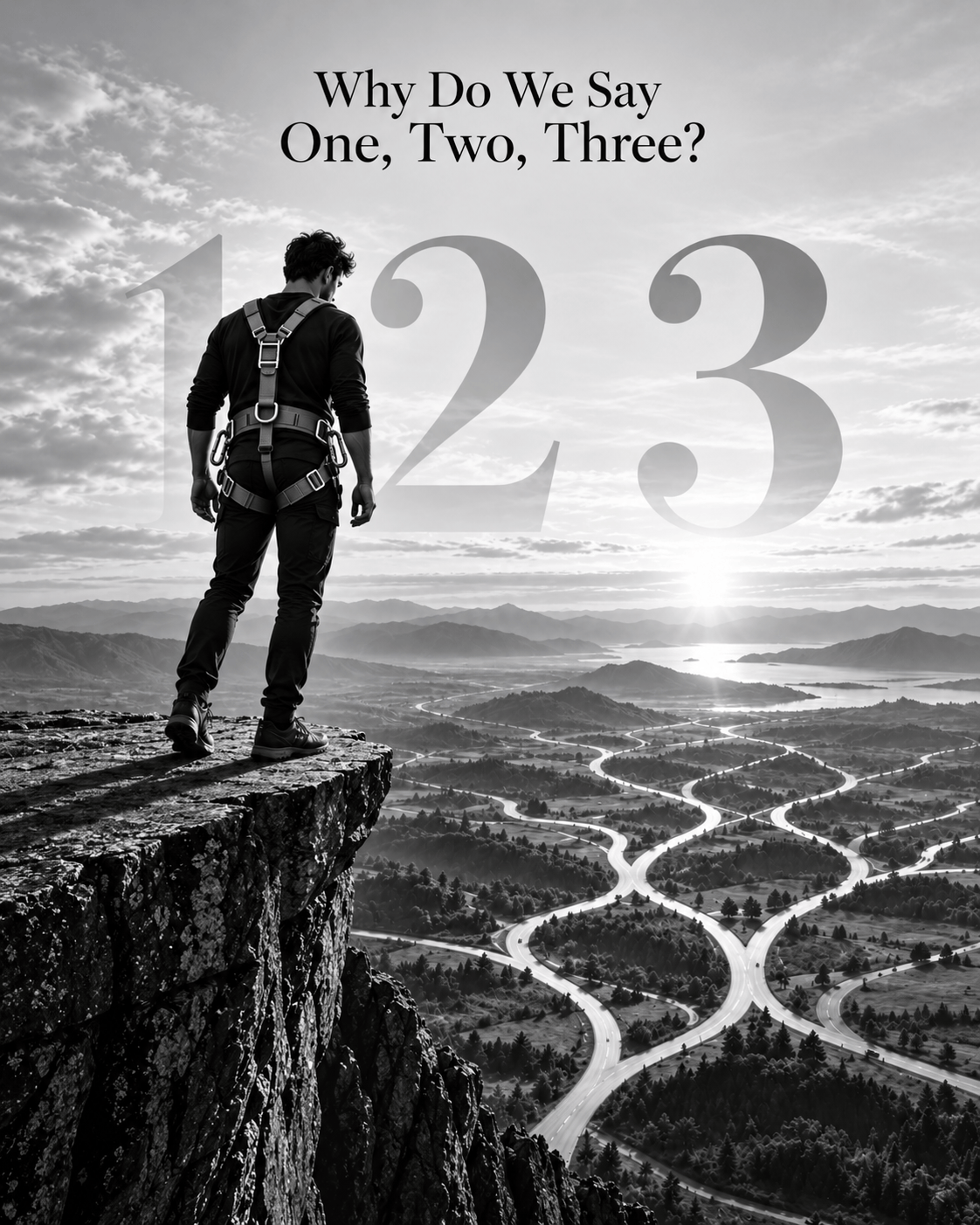
“Why do people say one, two, three before doing something?” I asked the Professor.
He looked at me suspiciously. “What sort of something?”
“Almost anything. Taking a photograph, lifting a heavy table, jumping into a swimming pool, starting a race.”
“Perhaps because going directly from thinking to doing is too abrupt.”
I had expected a joke. Instead, he had handed me the whole subject.
We learn one, two, three long before we understand fractions or compound interest, and the numbers themselves hardly matter. What matters is what the count does to people. Suppose four people are trying to move a heavy cupboard. All are strong enough and willing, but if they lift at different moments, the cupboard does not move. Someone says, “One, two, three,” and four independent people become one system. The count creates a common clock and converts individual intentions into coordinated action.
This may be one of humanity’s oldest management tools. No strategy document, no meeting, no PowerPoint. Just three numbers.
The Professor thought sustainability professionals should study this, and he had a point. Governments want decarbonisation, companies want net zero, investors want sustainable businesses, consumers want responsible products, cities want cleaner air and manufacturers want circularity. Everyone is standing around the same cupboard, yet everybody lifts at a different time. Perhaps the problem is not always a lack of intent. Sometimes we lack a shared three.

Why Not Just Say “Go”?
Because “go” arrives without preparation. A count creates a brief passage between the present and what comes next. At one, you become alert. At two, you prepare. At three, the decision feels almost irreversible.
Watch children at the edge of a swimming pool. At one, they look at the water. At two, they bend their knees. At three, they jump. Shout “Jump!” without warning and they may stay exactly where they are. The count coordinates us not only with others but with ourselves. It gives the mind time to catch up with what the body is about to do.
What About Three, Two, One?
The Professor pointed out that rockets go three, two, one rather than one, two, three. Are the two counts the same? Not quite. One-two-three feels as though something is being built: attention, readiness, action. Three-two-one feels as though something is disappearing: three seconds left, two, one, zero. The first builds towards action; the second closes the distance to it. One-two-three says, “Get ready.” Three-two-one says, “Time is running out.”
That is why reverse countdowns suit launches, deadlines and New Year’s Eve. With one-two-three, you are approaching the future. With three-two-one, the future is approaching you.
Climate change has quietly moved us from the first count to the second. The carbon budget shrinks every year, compliance dates arrive whether or not industry is ready, and 2030 is now closer to us than the Paris Agreement is. We are no longer counting up to action. The clock is counting down to us.
Government’s One, Two, Three
Governments face the same coordination problem on a much larger scale, and public policy can be read through the same three numbers.
One is direction: government identifies a problem, sets an objective and signals where it wants a country or sector to go.
Two is preparation: alternatives are developed, industries adjust, infrastructure and budgets are put in place, rules are clarified, and those affected are consulted.
Three is action: the regulation, mandate or programme takes effect.
Very often, the quality of two determines whether three works.
Take single-use plastics. Deciding that certain products should disappear from the market is relatively easy. The harder questions belong to two. Are alternatives available, and at what price? Can small manufacturers change production? Do retailers understand what is prohibited? Will consumers accept the substitutes?
A ban is the visible part of policy; transition is the part nobody photographs.
The Professor put it neatly: “You cannot remove the plastic spoon on Monday if you have forgotten to think about what people will use on Tuesday.”
When There Is No Public Countdown
There is an interesting exception. Some decisions lose their purpose if the count is heard in advance.
A central bank does not normally announce its exact next rate decision in advance, because markets would begin adjusting before the policy itself took effect. Similarly, the preparation of the Union Budget is conducted under strict confidentiality so that nobody can act in advance on tax or policy changes that have not yet been announced.
Here the count still happens, but behind closed doors. One and two are private; only three is public.
When the count is silent, the people affected get no time to prepare, so whoever is counting carries the whole burden of two.
Somebody Has to Count
This raises a question hidden inside all the others: who says “one, two, three”?
Usually one person does, and that person need not be the strongest at the cupboard, nor the most senior. Their role is simply to create coordination.
We often imagine leadership as knowing the answer. Sometimes it is making sure that everyone acts at the same moment: here is what we are moving, here is who needs to lift, here is what has to be ready first, and here is when we begin.
This matters enormously in sustainability transitions. Industry waits for regulation. Investors wait for bankable projects. Companies wait for customer demand, consumers for affordable products, and governments for industry readiness.
Everybody supports the destination; nobody wants to move first.
The problem is no longer simply technological or financial. It is choreography.
Perhaps Three Is Really About Trust
When four people lift a cupboard on three, each assumes the others will lift too. That is trust. If I suspect the others will quietly step away, I will not put my back into it.
Collective action therefore needs more than a common clock. It needs confidence that others will honour the count.
Companies invest when the policy signal is credible, consumers adapt when alternatives exist, and investors move when rules become predictable. One, two, three works because everybody believes that three means three.
A deadline that has been extended twice has taught everyone that three might mean four.
One, Two, Three… Infinity
Another famous journey begins with these same numbers.
George Gamow called his wonderful popular science book One Two Three… Infinity, and used simple counting to lead the reader towards the almost unimaginable: the very large, the very small, space, time and the universe itself.
In much of life, one, two and three prepare us for action. In Gamow’s world, they open a door.
He does not go to four.
He goes to infinity.
“That is rather ambitious,” said the Professor.
Perhaps. But artificial intelligence gives Gamow’s title an unexpectedly contemporary meaning.
Human work has traditionally followed a neat sequence: understand, prepare, act. AI unsettles it. Give it one question and it may produce several answers; develop one and several new directions open. Connect it to data, tools and other AI systems, and the pathways multiply quickly enough to make ordinary counting feel inadequate.
With most things, we count to three and jump.
With AI, we count to three and find ourselves looking at a landscape.
The challenge is no longer only when to jump, but in which direction, when there are suddenly so many.
The Professor’s Version
By now the Professor had heard enough of my arithmetic. He reduced it all to one sequence: know what you are trying to do, make yourself and those around you ready, and then stop counting.
That captures the tension behind many transitions. Sometimes two has to be broken into stages. Sometimes the clock runs backwards. Sometimes the counting happens behind closed doors. And sometimes, as Gamow and AI remind us, three opens onto more possibilities than we can explore, and choosing a direction becomes part of the jump.
The person who counts does not control everything that happens next. They create a moment when separate intentions can become collective action. This is why two deserves more respect than it receives. One gives us ambition. Three gives us action. Two carries the burden of making the transition credible.
Yet two cannot become a hiding place. There comes a point when another study adds little, another consultation changes little, and another roadmap merely redraws a familiar road.
Whether we are changing public policy, starting a sustainability programme or simply standing at the edge of a swimming pool, the count exists to carry us from intention to action. Preparation, reflection and planning all have value, but none was meant to become a permanent residence.
The purpose of one is to know that something must change.
The purpose of two is to become ready.
And the purpose of three is to make sure there is no four.
You jump.