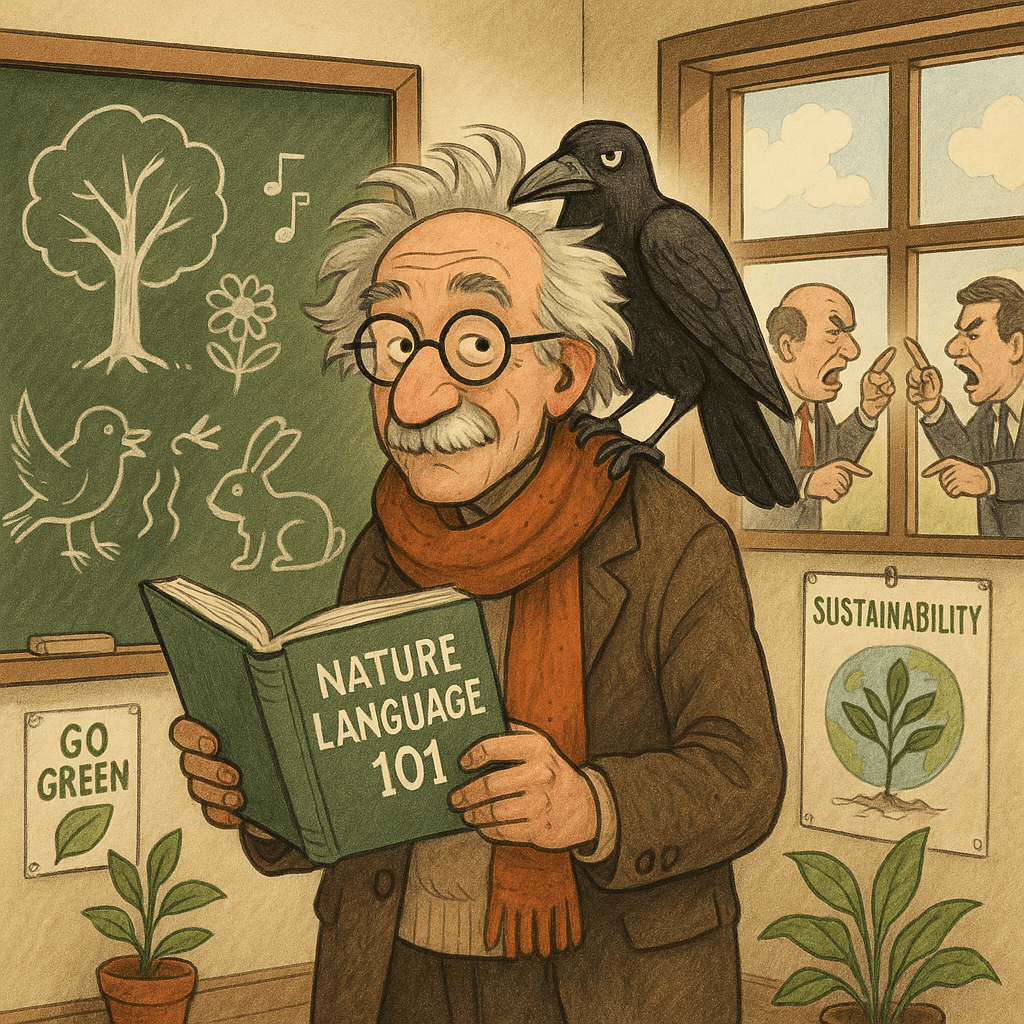
Over the years, I’ve come to a not so comfortable conclusion. The more I engage with humans, the more I long for the simplicity of a sparrow’s chirp or the rustling whispers of trees. Somewhere along the way, as we mastered the art of language, we lost the essence of conversation. Won’t you agree with me?
Words today are wrapped in agendas, tweets disguised as fake concern, boardroom speeches overflowing with jargon but devoid of honesty and truth. That’s extinct — or at least endangered.
My Professor Friend advises that I should unlearn and relearn the lost languages such as the language of birds, language of animals and the subtle language of plants. He says that you should talk to birds, animals and plants because they still tell the truth, and because they don’t manipulate and because their silence is not awkward — it’s wise.
Watch a crow cawing on your balcony. It isn’t worried about quarterly targets or pompous LinkedIn self-endorsements. It’s warning others of danger, marking its territory, or maybe just protesting the state of our insensitive urban planning. Honest. Raw. Unfiltered.
The trees? They whisper to each other underground through fungal networks — sharing resources, warning of pests. Scientists call it the Wood Wide Web. Imagine that — the trees collaborate better than our elected leaders.
We, the proud Homo sapiens, have designed countless languages. But somewhere between WhatsApp forwards, political speeches, and corporate webinars, truth got lost. Am I too cynical here?
You see, dolphins have signature whistles — names, in a sense. Birds call each other with specific alarm sounds. Dogs often understand human emotions better than humans themselves do. Meanwhile, at human conferences, we speak in circles so skillfully that nobody actually knows what’s being said — but everyone applauds. And we have now mastered the language of sustainability.
The other day, I attended one such grand event titled “Reimagining Purpose-Driven Sustainable Future for All “ or something equally incomprehensible. As I sat by the window, bored and bewildered, I noticed two crows perched on the ledge, quietly observing.

“What’s going on in there?” asked the first crow, fluffing its feathers.
“Oh, it’s the usual annual human ritual,” replied the second, “They call it a conference. It’s where they invent unfamiliar words to confuse each other while pretending to save the planet.”
“Impressive,” said the first crow. “Any real solutions?”
The second crow chuckled. “Not really. But the left over fish and chips are decent”
We exchanged glances—the crows and I—and for a while, I felt strangely aligned with their perspective. Honest. Observant. Disillusioned.
Isn’t it time to shift focus? Learn a language that hasn’t been corrupted?
Birds never lie. Trees never exaggerate. Wolves and Hyenas don’t network for self-promotion.
Maybe it’s time to spend less energy decoding conference speeches and more time listening to the quiet wisdom of a banyan tree by sitting underneath as many our sages did.
Be still. The language of plants is slow, patient. But it’s there — in the way leaves turn, roots stretch, flowers close at dusk. All we have to do is… listen.
So here’s what the Professor recommends for those tired of empty human words, course Nature 101. All it consists of:
Bird-Watching, Not Just for Hobbyists: It’s basic survival literacy. Understand alarm calls, mating songs, territorial debates.
Listen to the Trees: Pay attention. Their stillness speaks volumes.
Animal Empathy: Approach animals not as masters but as co-inhabitants.
And importantly, treat silence as Communication: Sometimes, saying nothing is the loudest statement.
As I was drafting these thoughts, I couldn’t help but notice the ongoing battle in Maharashtra, one of the most progressive States in India, where I live. People in Maharashtra are discussing which language should schools make mandatory? Marathi? Hindi? English? The political debates rage on, experts argue, social media explodes…
The language controversy in Maharashtra State in India revolves around the state government’s recent proposal to make Marathi, Hindi, and English all mandatory mediums of instruction in schools, reigniting long-standing debates over linguistic identity, cultural preservation, and educational priorities. While Marathi, as the state language, enjoys broad support for its promotion, making Hindi compulsory has sparked resistance from several quarters, including pro-Marathi groups, regional political parties, and linguistic activists. They argue that such a move undermines Maharashtra’s distinct Marathi identity and caters to central political agendas, potentially diluting regional pride and autonomy. Others express concerns over academic overload for students and the practicality of enforcing trilingual education. The controversy reflects deeper tensions in India around language, federalism, and the delicate balance between national integration and regional diversity.
And yet, not one wise soul has suggested the most crucial language of them all: The Language of Nature.
Yes, Nature Language (not the natural language that our AI specialists seem to know)— a language that’s been around far longer than Marathi, Hindi, or English, but unlike us humans, Nature hasn’t weaponized it for political mileage.
Imagine if, instead of rote grammar drills, our children spent an hour each day learning to: recognize bird calls, understand when a tree is stressed, notice the quiet sighs of an unhealthy river and hear the warning rustle of dry leaves before a forest fire!
Let me tell you, that would create not just literate students — but conscious, empathetic, environmentally-aware citizens.
But alas, teaching Nature Language doesn’t win elections. It only grows forests, saves water, and restores the lost trust. So as my Professor Friend says “ make Nature Language a mandatory subject in every school”
After all, when the last river dries, the last bird falls silent, and the last tree withers — I doubt your score in grammar and abundant vocabulary is going to save you and the earth.

Very thought provoking blog in todays chaotic world.
This hits really hard sir. It is very candid and whatever you have said sir is exactly the way it is. It really does makes us think real hard. I really agree with the crows observation… ” Only the fish and chips look decent “.
Very interesting article. Thanks for making us think.
In the village where I learned to stand, walk, run and climb, we were told that growing, foraging and eating food was primitive, and our family structures were rigid. To make our lives convenient, we were provided with convenience stores. Our homesteads and farmlands were sold to parachuted realtors to make our family structures flexible.Decades passed by. The remaining land parcels we had got fragmented and have gone vertical.
Then, the realtors started selling the yesteryear farmlands as Evergreen Gardens or Mountain View ultra-luxury villas. In the convenience stores, we saw pumpkin seeds, millets and moringa powder sold in haute couture packages. These premium products were bought by the occupants of Gardens and Villas, who now occupy the land where we cultivated millet and pumpkins earlier. Moringa was the unassuming, friendly homestead tree from which we plucked leaves and drumsticks. Now the sustainability gurus are beating the drum on us to eat ‘healthy’ and ‘local’.
With the relentless email, instant messaging, social media and OTT streams of distractions, the joy of casual ‘agendaless’ human conversation has been mostly lost. Given this communing with nature sadly stands little chance unless one decides to set the devices aside, leave the beaten path and swim against the current to speak to Mother Nature ……sometimes.